Call for Papers Theme Issue: Next-Generation Ambient Intelligence
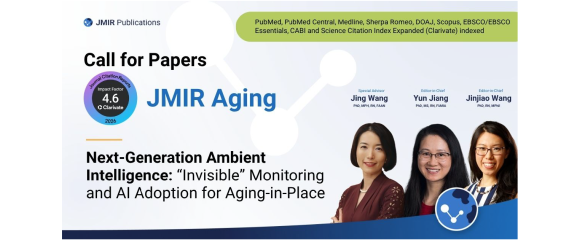
JMIR Aging invites submissions for an upcoming theme issue focused on next-generation home ambient intelligence: “invisible” monitoring and AI adoption for aging-in-place.
As the global demand for aging-in-place solutions intensifies, developing continuous, effective, and truly seamless support systems has become a cornerstone of digital health research for older adults. This theme issue aims to highlight the clinical efficacy and practical utility of next-generation ambient intelligence—specifically focusing on the paradigm of “invisible” monitoring. Furthermore, we seek to critically evaluate the socio-technical, ethical, and behavioral factors driving or hindering AI adoption among older adults, family caregivers, care partners, and health care providers.
We welcome original research, viewpoints, and literature reviews that address one or more of the following topics:
- Privacy-preserving “invisible” monitoring: Research on radar-based sensors such as smart home radar, light detection and ranging (LiDAR), and radio frequency–based ambient intelligence, including research evaluating the technical accuracy, real-world deployment, and clinical utility of unobtrusive ambient sensors for continuous fall detection, gait analysis, and mobility monitoring
- Computer vision and machine learning for health assessment: Studies applying computer vision and advanced AI models to safely analyze daily living activities, track nutritional intake, and predict early signs of physical or cognitive frailty in home environments
- Socio-technical drivers of AI adoption and user acceptance: Research exploring user experiences, patient trust, and the specific barriers or facilitators to AI adoption among older adults and their families, including studies on digital literacy, user-centered interfaces, and mitigating digital ageism
- Clinical implementation and health care provider adoption: Frameworks and case studies evaluating how clinicians, remote care teams, and health systems adopt, perceive, and use ambient intelligence data in routine care workflows
- Privacy, ethics, and electronic health record (EHR) integration of ambient AI: Technical strategies for privacy-preserving ambient sensing, alongside ethical frameworks regarding data autonomy and the seamless integration of continuous smart home–generated ambient data into EHRs
Special Advisor: Dr Jing Wang
We are honored to welcome Dr Jing Wang, PhD, MPH, RN, FAAN, the founding editor in chief of JMIR Aging, as the special advisor for this theme issue. A nationally recognized leader in digital health and health policy, Dr Wang brings unparalleled credibility to the intersection of AI, aging-in-place, and clinical practice. She currently serves as dean and professor at the Florida State University (FSU) College of Nursing, where her visionary leadership established the nation’s first Master of Science in Nursing focused on artificial intelligence applications in health care, launched the Smart Health Home™ initiative, and spearheaded an exclusive partnership with the Coalition for Health AI (CHAI) to launch a micro-credential program on responsible AI in nursing.
As co-director of the Nursing and AI Innovation Consortium, Dr Wang actively bridges the gaps between AI technology, nursing education, and real-world care. A Josiah Macy Jr. Foundation Faculty Scholar, a National Academy of Medicine Emerging Leader in Health and Medicine, and a Fellow of the American Academy of Nursing, her extensive advisory roles—including with the NIH National Advisory Council for Nursing Research, the Robert Wood Johnson Foundation, and the American Academy of Nursing’s Institute for Nursing Leadership—underscore her profound impact on the future of AI-driven health care innovation.
How to Submit
To submit an article to JMIR Aging, please visit the submission page. Consult our Instructions for Authors for more information on how to submit a manuscript. Standard APF applies.
Submission Deadline: January 31, 2027
Submission Guidelines
We will not accept articles that are solely written using generative AI or other AI tools. For more information, please refer to the JMIR Publications editorial policy and this knowledge base article.
All submissions will undergo a rigorous peer-review process, and accepted articles will be published as part of the theme issue titled “Next-Generation Ambient Intelligence: ‘Invisible’ Monitoring and AI Adoption for Aging-in-Place.”
All articles will be shared and published rapidly through the following mechanisms:
- All peer-reviewed articles will be immediately and permanently made open access. This is the standard for all titles within the JMIR Publications portfolio.
- Articles can be made immediately available (with a DOI) in JMIR Preprints after submission if authors select the preprint option at submission to enable this service.
Submissions not reviewed or accepted for publication in JMIR Aging may be offered cascading peer review or transfer to other JMIR Publications journals, according to standard policies. Authors are encouraged to submit study protocols or grant proposals to JMIR Research Protocols before data acquisition to preregister the study (as a registered report; subsequent acceptance in one of the JMIR Publications journals is then guaranteed).